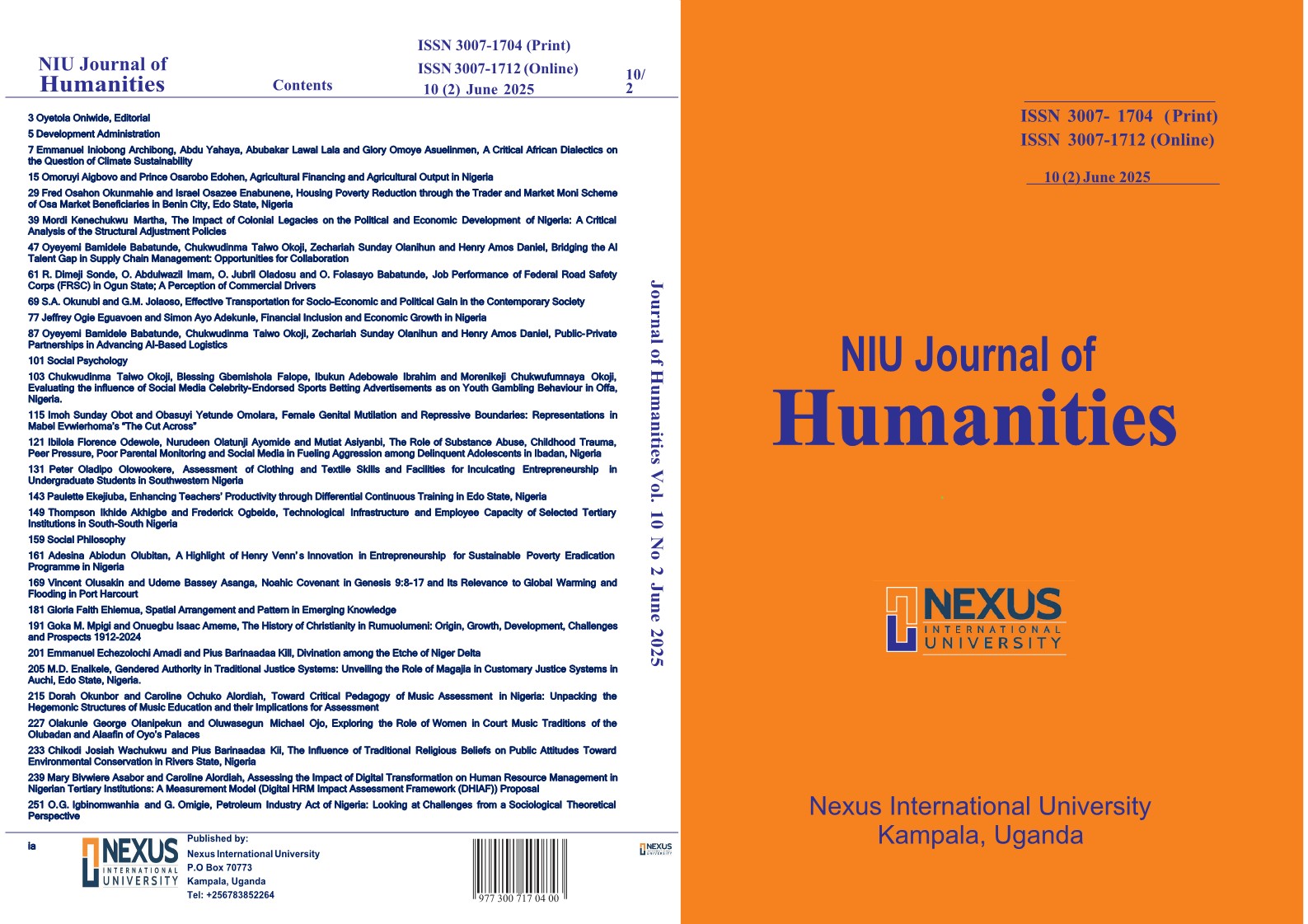
Financial Inclusion and Economic Growth in Nigeria
Abstract
The study investigated the link between financial inclusion and economic growth in Nigeria over the period 2009 to 2023. The specific objectives of the study were to find out whether automated teller machine (ATM), number of registered mobile money accounts (RMM), private credit to GDP (PCR), number of bank branches (NBB) and total volume of mobile money transactions to GDP (VMM) significantly affected economic growth. For this reason, the fully modified ordinary least squares (FMOLS) method was employed for the analysis of data and the results obtained indicated that automated teller machine (ATM), private credit to GDP (PCR), number of bank branches (NBB) and total volume of mobile money transactions to GDP (VMM) had significant positive relationship with economic growth; while the number of registered mobile money account (RMM) does not have any significant impact on economic growth in Nigeria. The study therefore concludes that financial inclusion is a significant determinant of economic growth in Nigeria within the period of investigation. Thus, it is recommended that, since automated teller machine (ATM) is a significant determinant of economic growth in Nigeria, regulators and indeed, management of banks must constantly provide the enabling environment for expansion of the use and functionality of automated teller machines (ATMs) so that it will continue to make positive impact on the Nigerian economy.
Keywords: Financial inclusion, Economic growth, Automated teller machine, Mobile money.